Home
Blog
Find 500 B2B Contacts for Free Every Month with Built-In Outreach.
Home
Blog
Manasa Goli
Published June 6, 2026
10 min

Try Oppora AI
Create Self-Running Agentic Sales Workflows like N8N just by chatting with AI
Get Started for FREE
Cold outreach works when your message reaches the right person with the right context at the right time.
The problem is that finding prospects, personalizing emails, managing follow-ups, and tracking performance can quickly become overwhelming as your outreach scales.
This is why more businesses are turning to AI-powered email marketing for cold outreach. AI can help automate repetitive tasks, improve personalization, identify better prospects, and optimize campaigns without requiring additional sales resources.
At the same time, it works best when paired with a clear strategy and human oversight.
In this guide, you'll learn:
Let's explore how AI can help you run smarter and more effective cold outreach campaigns.
AI has become a valuable tool for cold outreach because it can automate many of the tasks that traditionally consume a sales team's time.
However, it's important to understand where AI adds value and where human involvement is still necessary.
One of the biggest advantages of AI in cold email marketing is its ability to process large amounts of data quickly.
Instead of manually researching prospects, AI can identify relevant companies, decision-makers, and buying signals in a fraction of the time.
It can also generate personalized messaging based on factors such as a prospect's industry, role, company size, or recent activities.
Beyond personalization, AI helps execute campaigns more efficiently by automating prospecting, email creation, follow-ups, reply analysis, and performance tracking.
This allows you to spend less time on repetitive tasks and more time focusing on opportunities that require attention.
While AI can improve efficiency, it cannot decide who your ideal customers are or create a winning go-to-market strategy on its own.
AI works best when you provide clear inputs, goals, and direction.
For example, AI can generate outreach sequences and recommend improvements based on campaign performance.
But it still relies on your understanding of customer pain points, positioning, offers, and market dynamics.
Think of AI as an execution engine rather than a replacement for strategic decision-making.
The quality of your outreach still depends on the quality of the strategy behind it.
Cold outreach is ultimately about starting conversations with real people.
While AI can help initiate and manage those conversations, building trust often requires human judgment and context.
Prospects may ask complex questions, raise objections, or discuss business challenges that need thoughtful responses.
Human oversight also helps ensure messaging stays accurate, relevant, and aligned with your brand.
The most effective approach is combining AI's speed and scalability with the relationship-building skills that only people can provide.
When used this way, AI becomes a powerful partner in your outreach process rather than a replacement for it.
AI delivers the most value when it supports the repetitive and time-consuming parts of outreach.
From finding prospects to optimizing campaigns, it helps you move faster while keeping your outreach relevant and personalized.
AI can identify companies and decision-makers that match your ideal customer profile.
It also helps prioritize high-potential leads so you can focus on prospects that are more likely to convert.
Creating personalized emails manually doesn't scale.
AI can generate tailored messaging based on a prospect's role, company, industry, or recent activity, helping you personalize outreach across large campaigns.
Subject lines play a major role in email opens.
AI can generate multiple subject line variations and help identify which approaches perform best with your audience.
Consistent follow-ups are essential for cold outreach success.
AI can create structured follow-up sequences, suggest messaging variations, and help maintain engagement without constant manual effort.
As replies start coming in, AI can categorize responses based on interest level and intent.
This helps you identify qualified opportunities faster and prioritize the conversations that matter most.
AI can monitor campaign metrics such as opens, replies, and conversions.
It then uses those insights to recommend improvements, helping you continuously improve outreach performance over time.
Suggested Reading:
How to Check MX Record: Step-by-Step Guide for Any DomainKnowing where AI fits into cold outreach is helpful, but the real advantage comes when you connect all those activities into a single workflow.
Instead of using separate tools for prospecting, email creation, follow-ups, and reply management, Oppora combines everything into one AI-powered outreach process.
Here's how you can use it to scale your cold outreach efforts.
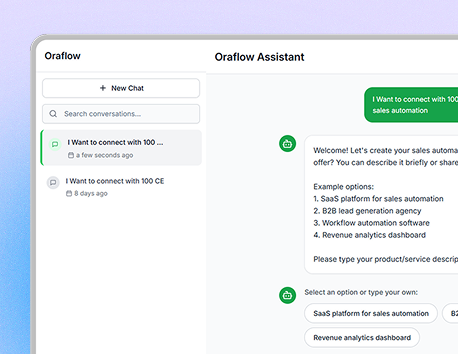
Every outreach campaign starts with understanding your offer and ideal customer profile (ICP).
With Oppora, you simply tell the platform what you sell and the type of companies or decision-makers you want to reach. This becomes the foundation for everything that follows, helping AI identify the right prospects and generate more relevant outreach.
Once your targeting criteria are defined, Oppora's AI helps discover companies that fit your ICP.
It can then identify the most relevant decision-makers within those organizations, allowing you to build highly targeted prospect lists without spending hours on manual research.
This helps ensure your outreach reaches people who actually have the authority to buy or influence purchasing decisions.
Having a prospect's name is not enough. You also need accurate contact information.
Oppora enriches lead records with additional data and verifies email addresses before campaigns begin. This helps reduce bounce rates, improve deliverability, and ensure you're reaching real contacts instead of outdated records.
Successful cold outreach rarely works with a single email.
Oppora allows you to build multi-step workflows that combine initial outreach, follow-ups, and engagement actions into one automated sequence.
This ensures every prospect receives consistent communication without requiring constant manual management.
Generic outreach is easy to ignore.
Oppora uses AI to generate personalized emails based on prospect information, company details, and campaign goals. Instead of relying on templates alone, the platform creates messaging that feels more relevant to each recipient.
This allows you to scale outreach while maintaining a personal touch.
Many prospects engage across multiple channels before responding.
With Oppora, you can add LinkedIn connection requests, messages, and follow-ups alongside your email campaigns. This creates a coordinated outreach strategy that increases visibility and improves response rates.
After your workflow is set up, Oppora handles campaign execution automatically.
The platform manages sending schedules, monitors campaign performance, and helps optimize outreach based on engagement data so you can focus on conversations instead of campaign administration.
As replies begin coming in, Oppora's AI can analyze responses, identify intent, and categorize prospects based on interest levels.
It can answer common questions, qualify leads, and help surface the opportunities that require immediate attention from your sales team.
When a prospect is ready to move forward, Oppora helps streamline the next steps.
Meetings can be scheduled automatically, while contacts, conversations, activities, and outcomes are synced directly to your CRM. This keeps your pipeline organized without requiring manual updates.
Suggested Reading:
How to Combine LinkedIn Outreach with Email CampaignsMost AI tools help with individual tasks. Oppora takes a different approach by connecting every stage of outreach through its AI Sales Agents.
From prospect discovery and data enrichment to email generation, reply handling, qualification, and CRM updates, the agents work together as a single system.
The result is a self-running outreach workflow that continues generating opportunities while reducing the amount of manual work required from your team.
Not all AI outreach tools offer the same capabilities. The best platforms combine automation, deliverability, and personalization features that help improve results while reducing manual work.
Real AI Personalization Instead of Spintext
Modern AI can generate unique messages based on prospect data rather than simply swapping a few words in a template.
This makes outreach feel more natural and relevant to each recipient.
AI-powered platforms can help you discover prospects from large databases of verified contacts.
This reduces the time spent searching for potential leads manually.
Sending emails to invalid addresses can hurt campaign performance.
Automated verification helps ensure you're reaching valid contacts while reducing bounce rates.
Email deliverability is critical for successful outreach.
Domain warm-up and deliverability tools help build sender reputation and improve inbox placement.
As outreach volume increases, mailbox rotation helps distribute sending activity across multiple inboxes.
This allows you to scale campaigns more safely.
Matching the sender's email provider with the recipient's can improve trust and deliverability.
This helps increase the chances of your emails being seen.
Managing replies across multiple campaigns can quickly become difficult.
A unified inbox keeps all conversations in one place, making follow-up and collaboration easier.
AI can analyze campaign performance and identify opportunities for improvement.
Combined with A/B testing, this helps you continuously optimize messaging, targeting, and outreach strategies.
Suggested Reading:
How to Generate B2B Leads on LinkedIn Without Manual ProspectingAs outreach grows, many businesses end up adding more tools, hiring additional team members, or spending more time managing processes.
Oppora helps you scale differently by automating key parts of the outreach workflow while keeping everything connected in one place.
Most outbound teams rely on separate tools for lead generation, email verification, outreach, follow-ups, inbox management, and CRM updates.
Oppora brings these functions together into a single workflow, reducing tool switching and making outreach easier to manage.
Tasks like prospect research, data enrichment, follow-up scheduling, and reply categorization can consume hours every week.
Oppora automates much of this work, allowing your team to spend more time engaging qualified prospects and closing opportunities.
Scaling outreach safely often requires more than one sending inbox.
Oppora supports multiple mailboxes while helping manage sending activity, making it easier to increase outreach volume without creating unnecessary deliverability risks.
One of the biggest challenges with scaling is maintaining relevance.
Oppora uses AI-powered personalization to generate tailored outreach for each prospect, helping you increase campaign volume while still delivering messages that feel personal and targeted.
AI can make your outreach more efficient, but results still depend on how well you use it. Following a few best practices can help you improve engagement, generate more qualified conversations, and avoid common mistakes.
AI performs best when it has clear targeting criteria.
Before launching campaigns, define your ideal customer profile based on factors such as industry, company size, job title, and business challenges. Better targeting leads to more relevant outreach and higher response rates.
Sending more emails doesn't always produce better results.
Instead of prioritizing volume, use AI to create personalized and relevant messaging that speaks directly to your prospect's needs. A smaller, highly targeted campaign often outperforms a larger generic one.
Prospects interact with multiple channels throughout the buying journey.
Combining email outreach with LinkedIn connection requests and follow-ups helps increase visibility and creates more opportunities to start conversations.
Successful outreach campaigns are rarely built in a single attempt.
Track metrics such as open rates, replies, meetings booked, and bounce rates regularly. These insights help you identify what's working and where improvements are needed.
Don't limit AI to writing emails alone.
Use it across prospecting, personalization, follow-ups, reply management, and campaign analysis. When AI supports the entire outreach workflow, it becomes much easier to scale results while maintaining efficiency.
AI is changing cold outreach by making it easier to find prospects, personalize messages, automate follow-ups, and optimize campaigns at scale.
However, the best results come from using AI to support your strategy rather than replace it. Clear targeting, relevant messaging, and continuous optimization still play a major role in campaign success.
By combining AI-powered prospecting, personalization, outreach automation, and performance insights, you can build a more efficient system for generating conversations and qualified opportunities.
Platforms like Oppora take this a step further by connecting every stage of the outreach process into a single workflow.
Instead of managing multiple tools and repetitive tasks, you can automate prospecting, outreach, reply handling, meeting booking, and CRM updates from one place.
The result is a scalable cold outreach process that helps you reach more prospects, book more meetings, and grow your pipeline without growing your workload.
AI analyzes prospect data such as job titles, industries, company information, and business signals to generate more relevant messages. This helps create personalized outreach at scale without manually writing every email.
AI doesn't replace traditional email marketing but enhances it. It helps automate repetitive tasks, improve targeting, and optimize campaign performance, allowing teams to achieve better results with less manual effort.
Yes. Many AI-powered outreach platforms can analyze incoming replies, detect intent, answer common questions, qualify leads, and prioritize conversations that require human attention.
Using both channels increases visibility and creates multiple opportunities to engage prospects. A coordinated email and LinkedIn strategy often generates higher response rates than relying on a single channel.
Summarize with AI
Share