Home
Blog
Oppora’s Claude MCP is Live. Connect our Email Database & Outreach features with any tool to build smart automations inside Claude.
Home
Blog
Manasa Goli
Published July 22, 2026
9 min
Try Oppora AI
Create Self-Running Agentic Sales Workflows like N8N just by chatting with AI
Get Started for FREE
Your prospects don't buy after seeing just one email anymore.
They discover your company on LinkedIn, open an email days later, visit your website, compare alternatives, and only then decide whether you're worth replying to.
That's why relying on a single outreach channel isn't enough.
Modern B2B buyers expect relevant communication across multiple touchpoints, and your sales process needs to keep up without creating more manual work for your team.
Research from RAIN Group found that it takes an average of 8 touchpoints to secure an initial meeting with a prospect.
Meanwhile, Gartner reports that a typical B2B buying group now includes 6 to 10 decision-makers, making consistent outreach even more important.
This is where multichannel sales automation makes the difference.
Instead of manually juggling emails, LinkedIn messages, follow-ups, CRM updates, and meeting scheduling, you create one workflow that automatically delivers the right message through the right channel at the right time.
In this guide, you'll learn:
Now that you know why multiple touchpoints matter, the next step is understanding how they work together.
A multichannel sales automation workflow is a predefined sequence that automatically engages prospects across multiple channels based on their actions. Instead of manually deciding what to do next, the workflow keeps your outreach moving from one step to another.
A typical workflow looks like this:
The biggest advantage is consistency. Every prospect receives timely follow-ups without your team having to remember who to contact next.
Instead of spending hours managing spreadsheets, switching between tools, or tracking follow-ups, your sales team can focus on what matters most—having meaningful conversations and closing more deals.
A successful workflow isn't just about adding more channels. Every step should move prospects closer to a conversation without making your outreach feel repetitive or spammy.
Here are the seven building blocks every high-converting multichannel sales automation workflow should include.
Even the best outreach strategy won't work if you're targeting the wrong people.
Research from Cognism found that over 40% of sales reps say poor-quality data is one of their biggest obstacles to closing deals.
Outdated emails, missing contact information, and irrelevant prospects lead to wasted effort and lower reply rates.
Before launching your workflow, make sure you:
When your data is accurate, every channel in your workflow performs better because you're reaching people who are actually likely to buy.
Automation saves time, but personalization is what gets replies.
In fact, McKinsey found that 71% of consumers expect personalized interactions, and 76% get frustrated when businesses fail to deliver them.
While the research spans industries, the same expectation applies to B2B buyers who receive dozens of outreach messages every week.
Instead of sending the same template to everyone, tailor your messaging using details like:
AI can make this process scalable by creating personalized messages for every prospect without requiring manual research.
The more relevant your outreach feels, the more likely prospects are to respond instead of ignoring another generic sales email.
Reaching out on multiple channels doesn't mean contacting prospects everywhere at once.
The goal is to create a natural sequence that keeps the conversation moving without overwhelming them.
A simple workflow could look like this:
This approach gives prospects enough time to engage while keeping your brand top of mind.
Remember, consistency beats frequency. A well-timed sequence across two or three channels is far more effective than sending multiple messages on the same day.
Not every prospect should receive the same follow-up. The best workflows adapt based on how people interact with your outreach.
For example, you can trigger different actions when a prospect:
Behavior-based automation keeps your outreach relevant instead of sending the same sequence to everyone, improving both engagement and conversions.
Following up consistently is essential, but writing every message manually isn't scalable.
Instead of sending generic reminders, use AI to generate personalized follow-ups based on previous interactions.
This helps every email feel natural while saving hours of manual work.
Aim for 4–6 follow-ups over a few weeks, as many prospects simply aren't ready to respond after the first message.
Suggested Reading:
11 Best AI SDR Tools for Smarter Sales AutomationYour workflow shouldn't end when a prospect replies.
Automatically syncing contacts, emails, meetings, and deal updates to your CRM ensures your pipeline stays accurate without manual data entry.
A connected system also helps your entire sales team:
Even the best workflow needs regular optimization.
Track key metrics like:
Use A/B testing to experiment with subject lines, messaging, and timing.
Small improvements across each step can significantly increase the number of replies and meetings your workflow generates over time.
So far, you've learned what makes a successful multichannel sales automation workflow. Now it's time to build one.
Many businesses still use one platform for finding leads, another for verifying emails, another for sending campaigns, another for LinkedIn outreach, and another for CRM updates.
Besides increasing software costs, switching between multiple tools slows your team down and often results in missed follow-ups.
Oppora solves this by bringing the entire outbound process into a single Agentic Workflow Builder.
Instead of manually completing every task, you simply design the workflow once and let 8 AI Sales Agents execute it automatically—from prospecting to meeting booking.
Here's how you can build your first multichannel workflow.
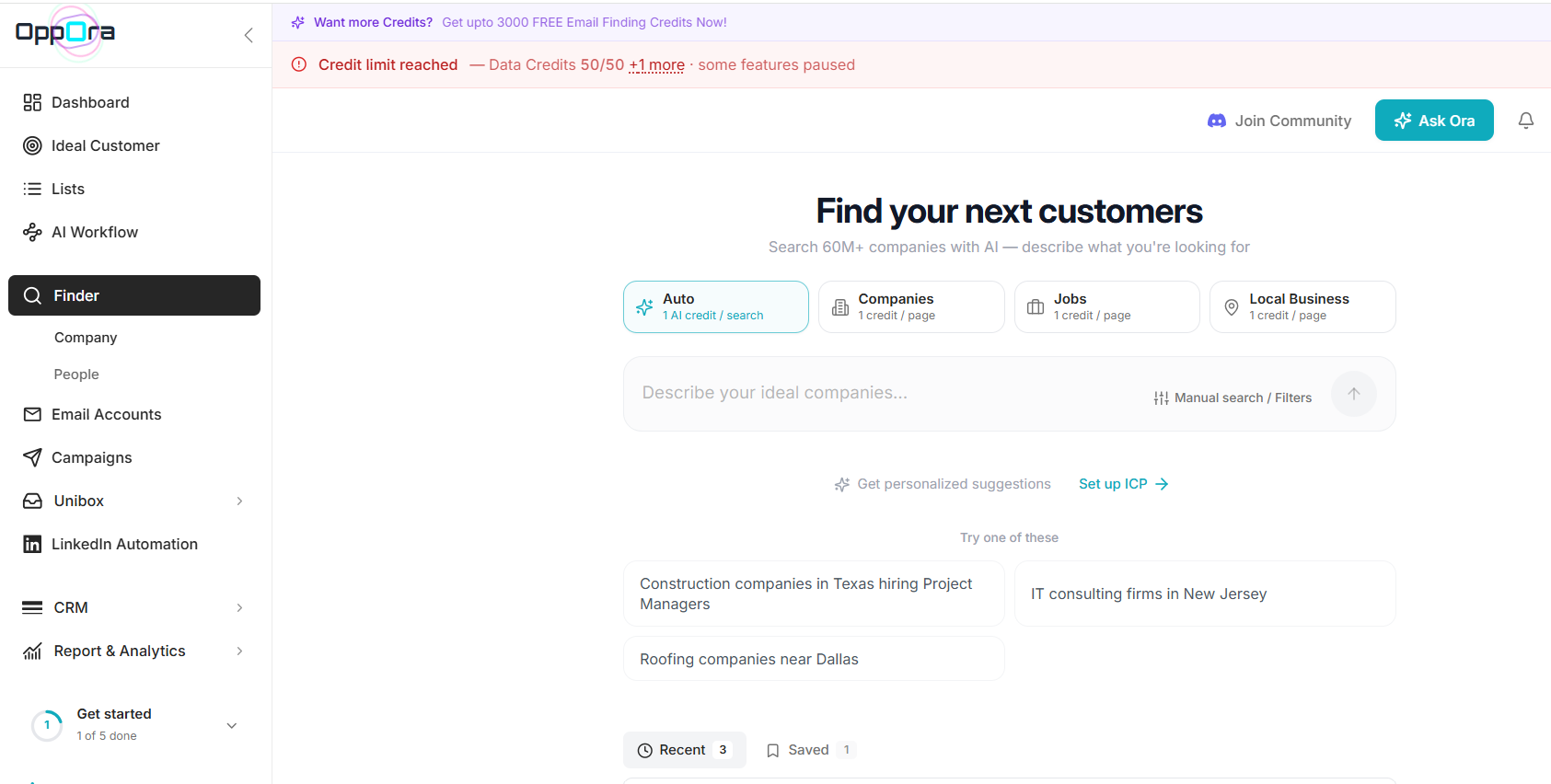
Every successful campaign starts with the right audience.
Begin by defining your Ideal Customer Profile (ICP). You can search companies using filters like:
Once you've selected your criteria, Oppora searches across 120M+ verified contacts to identify companies and the right decision-makers.
It then enriches each profile with verified contact information before they're added to your workflow.
This gives you a clean, qualified prospect list before your outreach even begins.
Now open Oppora's Agentic Workflow Builder.
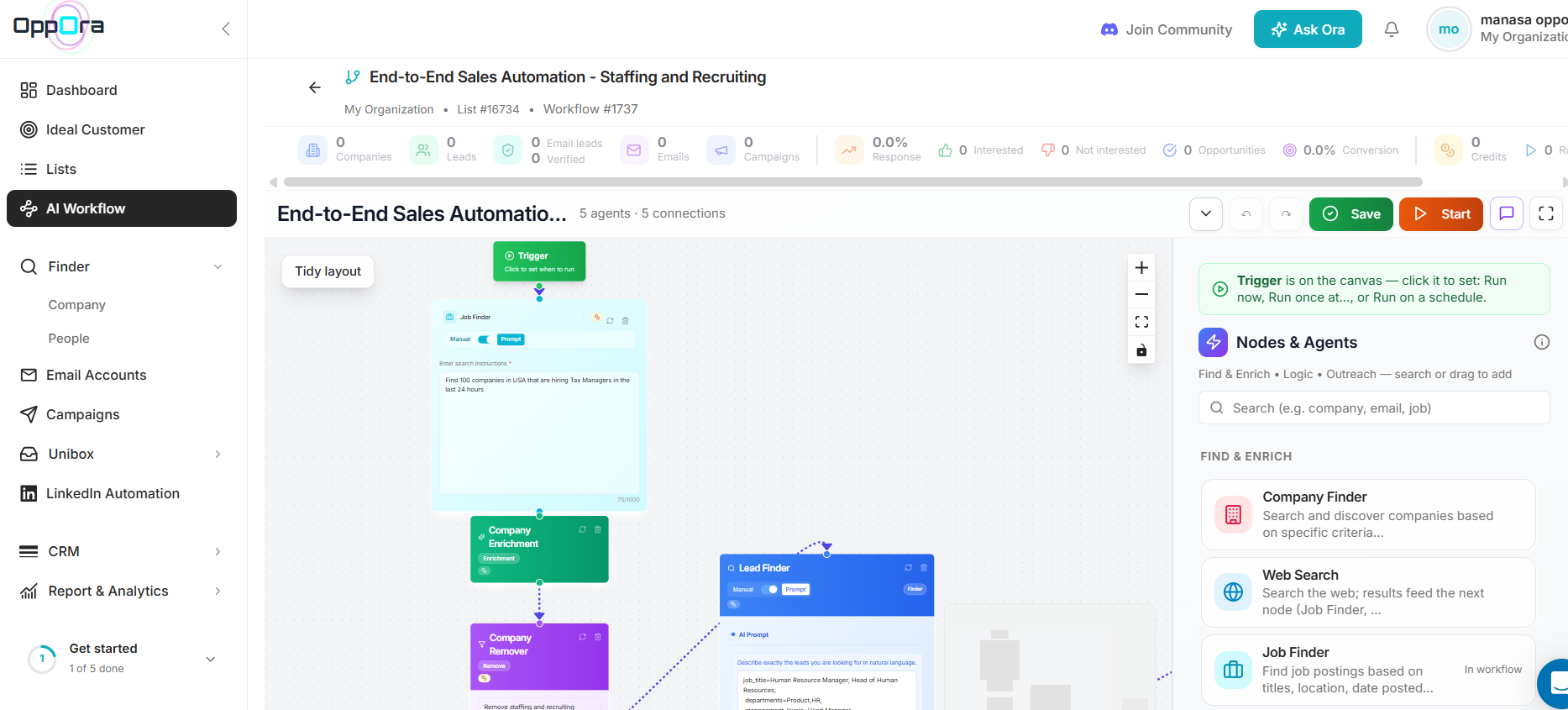
Instead of configuring multiple disconnected tools, simply drag the AI Sales Agents into the order you want them to execute.
A typical multichannel workflow might look like this:
Each agent automatically completes its task before passing the lead to the next stage, creating one continuous workflow instead of isolated processes.
Once the workflow is published, the agents continue executing it automatically without requiring manual intervention.
With your workflow ready, it's time to define how prospects should move through your campaign.
For example, you could build a sequence like this:
Instead of manually remembering every follow-up, the workflow ensures each prospect receives the next touchpoint at exactly the right time.
Automation works best when every message feels personal.
Rather than sending the same email to hundreds of prospects, Oppora's AI generates unique outreach based on each lead's profile and company information.
It also automatically responds to common questions, shares relevant information, qualifies interested prospects, and moves qualified leads further down the sales pipeline.
This allows you to scale outreach while still delivering conversations that feel human.
Growing outreach volume shouldn't come at the cost of deliverability.
Oppora includes built-in safeguards like email verification, domain warm-up, mailbox rotation, and sender identity matching to help improve inbox placement.
You can also connect up to 50 mailboxes, allowing you to safely scale campaigns without relying on a single sending account.
These safeguards help your campaigns reach prospects' inboxes instead of spam folders.
Once prospects engage, every interaction should be recorded automatically.
Oppora syncs contacts, replies, meetings, and pipeline updates with popular CRMs like HubSpot, Salesforce, and Pipedrive, eliminating manual data entry and giving your sales team a complete view of every prospect's journey.
Launching your workflow isn't the final step.
Track important metrics like:
Use these insights to refine your messaging, optimize follow-up timing, and improve conversion rates over time.
Once your workflow is live, Oppora's AI Sales Agents continue prospecting, personalizing, following up, replying, and updating your CRM automatically.
Instead of managing multiple tools and repetitive tasks, your sales team can focus on building relationships and closing more deals.
Even a well-designed workflow can underperform if it's built on the wrong strategy. Avoiding a few common mistakes can make a big difference in your results.
Here are some pitfalls to watch out for:
The goal of multichannel sales automation isn't to send more messages—it's to deliver the right message through the right channel at the right time.
Building a successful multichannel sales automation workflow isn't about being present on every channel.
It's about creating a connected system that reaches prospects with the right message at the right time.
Start with quality lead data, personalize your outreach, build a thoughtful sequence, and let automation handle repetitive tasks like follow-ups and CRM updates.
As your campaigns grow, keep tracking key metrics and optimizing your workflow to improve conversions.
Remember, automation should enhance the buyer experience—not replace human relationships.
When used strategically, it helps your team spend less time on manual work and more time having meaningful conversations that lead to qualified meetings and closed deals.
While every audience is different, research suggests it takes around 8 touchpoints on average to book a meeting with a prospect.
A balanced sequence spread over two to three weeks usually performs better than aggressive daily outreach.
Yes. AI can identify prospects, personalize emails, automate follow-ups, qualify replies, and update your CRM automatically.
This helps sales teams scale outreach without sacrificing personalization.
Review your workflow at least once a month. Analyze metrics like reply rates, meeting bookings, and conversions to identify bottlenecks.
Small improvements to your messaging, timing, or channel sequence can significantly improve campaign performance over time.
Summarize with AI
Share