Growth teams no longer run campaigns from one dashboard and data from another.
You need a system that connects channels, workflows, leads, personalization, and reporting without slowing your team down.
In this guide, you’ll see:
- What marketing orchestration tools actually do
- Which platforms top teams use
- How to choose the right one for your growth motion
Why Marketing Orchestration Has Become Essential for Modern Growth Teams
Marketing used to be easier to manage when teams had fewer channels, fewer tools, and simpler customer journeys.
Now your buyers may discover you on LinkedIn, click an ad, visit your website, read an email, ignore three follow-ups, return through a webinar, and finally book a demo from a retargeting campaign.
That is why marketing orchestration has become essential. It helps you connect every moving part so your campaigns feel coordinated instead of scattered.
Unified Marketing Stacks Improve Campaign Efficiency
When your marketing stack is disconnected, your team spends more time moving data than improving campaigns.
One person exports leads. Another checks CRM fields. Someone else builds segments, updates spreadsheets, and tries to understand which campaign actually worked.
A marketing orchestration platform brings these pieces into one connected workflow.
Your team can plan campaigns, trigger actions, sync data, manage follow-ups, and track results without jumping between ten different tools.
This does not just save time. It also reduces mistakes, duplicate work, and missed opportunities.
Cross-Channel Customer Journeys Drive Better Engagement
Your buyers do not think in channels. They think in moments.
They may see your brand in one place, research you in another, and respond somewhere completely different.
Marketing orchestration helps you design journeys around how people actually behave.
Instead of sending the same message to everyone, you can create campaigns that adapt based on actions, intent, and engagement.
That means your emails, ads, LinkedIn touches, SMS messages, and website experiences can work together instead of competing for attention.
Marketing Orchestration Connects Teams, Data, and Workflows
Growth does not happen only inside the marketing team anymore.
Sales needs context. RevOps needs clean data. Customer teams need visibility. Leadership needs reporting they can trust.
Marketing orchestration connects these teams through shared workflows and real-time data.
Everyone can see what happened, what should happen next, and where each lead or customer stands in the journey.
That is what makes orchestration more valuable than basic automation.
It does not just complete tasks. It helps your entire growth engine move in the same direction.
A good marketing orchestration tool should not just automate tasks.
It should help you build connected campaigns where data, channels, teams, and customer actions work together without constant manual effort.
In 2026, the best tools will make your marketing feel less like tool management and more like a clear growth system.
Here are the key capabilities to look for:
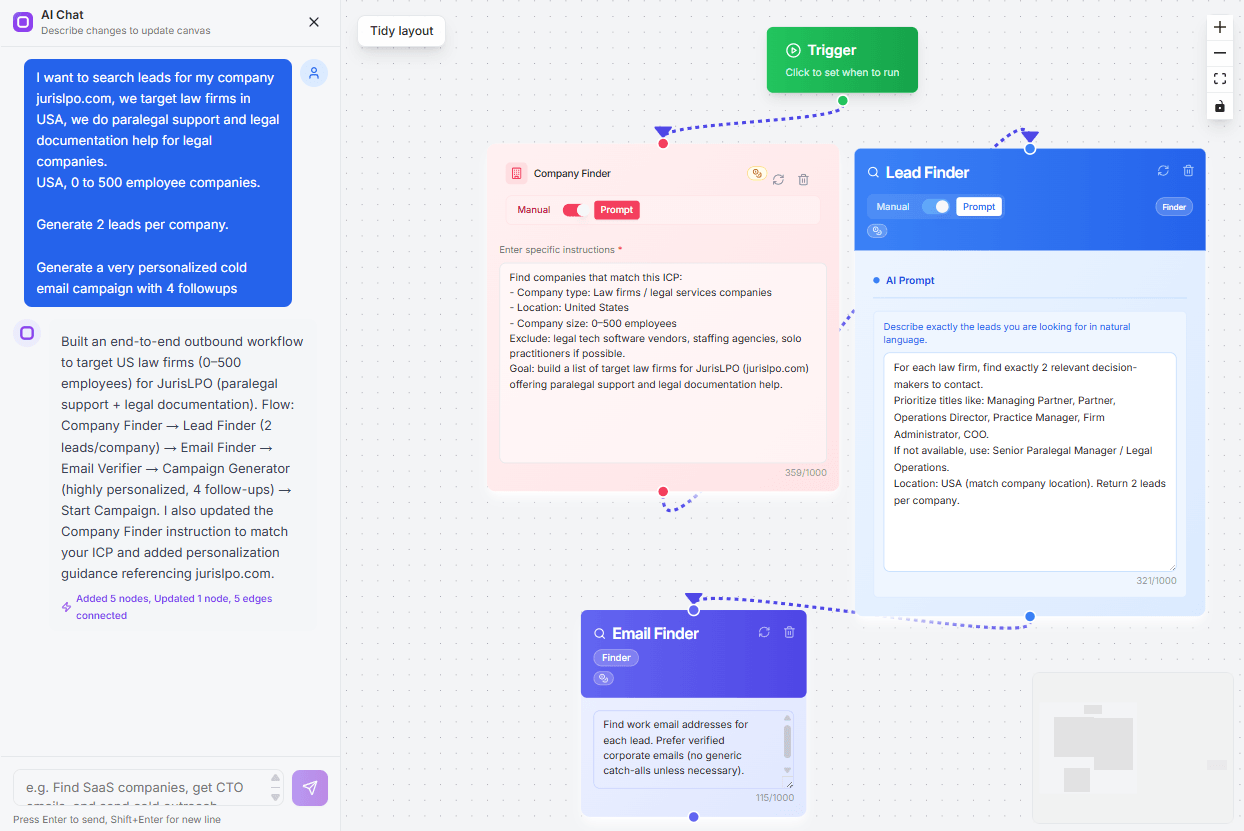
- AI-powered workflow builder: Your tool should help you create workflows faster, not force you to build every step manually. AI can turn campaign goals into sequences, triggers, actions, and follow-ups your team can review and improve.
- Multi-channel campaign management: Modern buyers move across channels before they take action. Your platform should support email, LinkedIn, ads, website activity, and other touchpoints from one connected campaign view.
- CRM and third-party integrations: Your CRM should not sit outside your marketing workflow. A strong orchestration tool connects with your CRM, enrichment tools, sales platforms, analytics apps, and customer data sources.
- Customer journey mapping: You need to see how people move from first touch to conversion. Journey mapping helps you understand where buyers engage, where they drop off, and what message should come next.
- Lead enrichment and data quality: Bad data breaks even the best campaign. Look for tools that enrich, verify, clean, and update lead data before your team starts outreach or personalization.
- AI personalization: Personalization should go beyond adding a first name. AI can help create messages based on role, company, intent, pain points, and previous engagement.
- Reporting and attribution: You should know what is working without building reports from scratch. Strong reporting connects campaigns, channels, pipeline, revenue, and attribution in one place.
- Ease of setup and scalability: The right tool should be easy to launch but strong enough to grow with you. You want simple setup, flexible workflows, and room to scale as campaigns become more advanced.
Before you compare each platform in detail, it helps to see where every tool fits.
Some marketing orchestration tools are built for enterprise customer journeys. Some are better for email automation, lifecycle messaging, or app integrations.
Others, like Oppora.ai, focus more on AI outbound orchestration for B2B growth teams that want prospecting, LinkedIn, email, workflows, and follow-up automation in one place.
Use this table as a quick scan before choosing which tools to explore deeper.
Tool | Best For | Key Strength | AI | Channels | Pricing |
Oppora.ai ⭐ | B2B Growth Teams | AI Outbound Orchestration | ⭐⭐⭐⭐⭐ | LinkedIn, Email, AI Workflows | Free + Paid |
HubSpot Marketing Hub | SMBs | CRM + Marketing | ⭐⭐⭐⭐ | Multi-channel | Paid |
Salesforce Marketing Cloud | Enterprise | Journey Orchestration | ⭐⭐⭐⭐ | Omnichannel | Custom |
Braze | Mobile Apps | Customer Engagement | ⭐⭐⭐⭐ | Email, SMS, Push | Custom |
Adobe Journey Optimizer | Enterprise | Personalized Journeys | ⭐⭐⭐⭐ | Omnichannel | Custom |
Pega Customer Decision Hub | Enterprise | AI Decisioning | ⭐⭐⭐⭐⭐ | Cross-channel | Custom |
Insider | E-commerce | AI Personalization | ⭐⭐⭐⭐ | Multi-channel | Custom |
Iterable | Lifecycle Marketing | Customer Engagement | ⭐⭐⭐⭐ | Multi-channel | Custom |
Customer.io | Product-Led SaaS | Event-Based Automation | ⭐⭐⭐⭐ | Email, SMS | Paid |
Zapier | Workflow Automation | App Integrations | ⭐⭐⭐ | 7,000+ Apps | Free + Paid |
ActiveCampaign | SMBs | Email Automation | ⭐⭐⭐ | Email + CRM | Paid |
Now that you know what to look for, let’s compare the tools more practically.
The goal is not to find the “biggest” platform. It is to find the one that matches how your team grows, where your customers engage, and how much orchestration you actually need.
Oppora.ai is built for B2B teams that want outbound marketing to run as one connected growth system.
Instead of using one tool to find leads, another to verify emails, another to write messages, and another to manage replies, Oppora.ai connects the full workflow through AI sales agents.
You can tell Oppora.ai what you sell and who you want to reach. Then its AI agents help find leads, enrich data, personalize outreach, send emails, manage replies, and sync meetings back to your CRM.
This makes it especially useful for teams that want marketing orchestration focused on the pipeline, not just campaign activity.
Best For
Oppora.ai is a strong fit for:
- B2B growth teams
- Founders and solopreneurs
- SDR teams
- Sales agencies
- Staffing firms
- IT service companies
- B2B companies selling to decision-makers
If your team depends on outbound growth, Oppora.ai gives you a way to connect prospecting, email, LinkedIn, personalization, replies, and CRM updates without managing everything manually.
Key Features
- AI workflow builder for outbound campaigns Build self-running workflows where AI agents handle prospecting, enrichment, outreach, replies, and CRM updates from one connected flow.
- 1B+ contact database for lead discovery Find relevant prospects faster using a large contact database across industries, job roles, company types, and target markets.
- 8 AI sales agents working together Oppora’s agents are designed to manage different parts of the outbound process, from finding leads to replying from your inbox and booking meetings.
- Email and LinkedIn outreach in one sequence Combine email and LinkedIn touchpoints in the same workflow, so your campaigns feel coordinated across channels.
- Lead enrichment and email verification Clean, enrich, deduplicate, and verify leads before outreach begins. This helps reduce bounce rates and improve outreach quality.
- AI-personalized email writing Oppora.ai creates personalized messages using real AI instead of relying only on generic templates or spintext.
- AI reply handling from your inbox The AI can answer questions, handle objections, send attachments, qualify interest, and book meetings directly from your inbox.
- Deliverability controls Oppora supports domain warmup, mailbox rotation, sender identity matching, and safe sending controls to help protect sender reputation.
- CRM sync and integrations Sync contacts, replies, meetings, deals, and tasks into tools like HubSpot, Salesforce, Pipedrive, or Oppora CRM.
Pros
- Combines lead discovery, enrichment, outreach, replies, and CRM sync
- Strong fit for B2B outbound orchestration
- Supports both email and LinkedIn outreach
- Uses AI across the workflow, not only for writing copy
- Offers separate credits for different tasks instead of one shared credit pool
- Includes unlimited campaigns and unlimited email sending, with limits based mainly on unique recipients
- Supports credit rollover and mini pricing packs for more flexible usage
Cons
- Better suited for B2B outbound than broad B2C lifecycle marketing
- Not ideal if your main focus is mobile push notifications or e-commerce product recommendations
- Teams should still review workflows and messaging before scaling campaigns
Pricing
- Free plan: Available for teams that want to start without upfront cost.
- 7-day trial: Available if you want to test the platform before choosing a paid plan.
- Pro plan: Starts at $34/month.
- Max plan: Starts at $79/month.
- Enterprise plan: Starts at $499/month.
- Mini credit packs: Available from $7/month, useful when you only need extra credits like email search without upgrading your full plan.
2. HubSpot Marketing Hub — Best for CRM-Centric Marketing
HubSpot Marketing Hub is a strong choice when you want marketing orchestration connected closely to your CRM.
It works well for teams that manage lead capture, email marketing, landing pages, automation, segmentation, reporting, and sales handoff from one platform.
Best For
HubSpot is a good fit for:
- SMBs
- Inbound marketing teams
- B2B teams using HubSpot CRM
- Companies focused on lead nurturing
- Teams that want marketing and sales data together
Key Features
- CRM-connected campaign management
- Email marketing and automation
- Forms, landing pages, and lead capture
- Segmentation and personalization
- Reporting and attribution
- AI support through HubSpot Breeze
Pros
- Easy to use for growing teams
- Strong CRM and marketing connection
- Helpful for inbound and lead nurturing
- Large integration ecosystem
- Good visibility across the funnel
Cons
- Pricing can rise as contacts and features grow
- Advanced automation is usually on higher plans
- Less focused on outbound orchestration than B2B prospecting-first tools
Pricing
- Free plan available
- Starter starts at $10/month per seat
- Professional starts at $890/month
- Enterprise pricing is available for larger teams
3. Salesforce Marketing Cloud — Best for Enterprise Customer Journeys
Salesforce Marketing Cloud is built for large teams that need advanced customer journey orchestration across email, mobile, web, and CRM data.
It is a strong fit when your marketing, sales, service, and customer data already live inside the Salesforce ecosystem.
Best For
Salesforce Marketing Cloud works best for:
- Enterprise teams
- Large B2C brands
- Salesforce-heavy companies
- Teams managing complex customer journeys
- Businesses with advanced data and governance needs
Key Features
- Email, mobile, and web journey automation
- Enterprise customer segmentation
- Journey Builder for lifecycle campaigns
- Salesforce CRM and Data Cloud connection
- Personalization and AI-assisted campaign capabilities
- Reporting across customer touchpoints
Pros
- Strong enterprise journey orchestration
- Deep Salesforce ecosystem connection
- Good for large-scale customer engagement
- Supports complex segmentation and governance
Cons
- Can be expensive for smaller teams
- Usually needs implementation support
- More complex than lightweight marketing tools
Pricing
- Pro+ starts at $2,000/org/month
- Corporate+ starts at $5,500/org/month
- Enterprise+ starts at $30,000/org/month
Salesforce says Marketing Cloud Engagement is designed to personalize and automate email, mobile, and web journeys at scale.
4. Braze — Best for Omnichannel Customer Engagement
Braze is built for teams that need to engage customers across many digital touchpoints.
It works especially well for mobile-first brands, apps, and consumer companies that want customer engagement to feel timely, personalized, and connected across channels.
Best For
Braze is a good fit for:
- Mobile apps
- Consumer brands
- Subscription businesses
- Retail and e-commerce teams
- Lifecycle marketing teams
Key Features
- Cross-channel messaging
- Email, push, SMS, WhatsApp, and in-app messaging
- Journey orchestration through campaigns and canvases
- BrazeAI features for personalization and optimization
- Reporting, analytics, and experimentation
- Customer data activation across channels
Pros
- Strong omnichannel engagement features
- Good fit for mobile and app-based customer journeys
- Built-in AI, testing, and personalization tools
- Flexible for high-volume customer messaging
Cons
- May be too advanced for small teams
- Pricing is not simple flat-rate public pricing
- Better for customer engagement than B2B outbound prospecting
Pricing
- Platform editions include Braze Go, Select, Pro, and Enterprise.
- Pricing scales with monthly active users.
- Braze also uses Action Credits across channels and some BrazeAI products.
5. Adobe Journey Optimizer — Best for Personalized Customer Experiences
Adobe Journey Optimizer is built for teams that want to create personalized customer journeys across many channels.
It works best when your company already uses Adobe Experience Platform and needs real-time customer profiles, journey orchestration, content, decisioning, and campaign delivery in one place.
Best For
Adobe Journey Optimizer is a good fit for:
- Enterprise brands
- Retail and travel companies
- Financial services and healthcare teams
- Adobe Experience Cloud users
- Teams focused on real-time personalization
Key Features
- Unified customer profiles and audiences
- Real-time journey orchestration
- Email, web, app, mobile, and in-person channels
- AI decisioning and next-best-action support
- Dynamic content personalization
- Campaign orchestration and governance
Pros
- Strong personalization across customer journeys
- Works well with Adobe Experience Platform
- Good for complex enterprise use cases
- Useful AI and decisioning features
Cons
- Not ideal for small teams
- Setup can be complex
- Best value comes when you already use Adobe’s ecosystem
Pricing
- Pricing is customized based on business needs.
- Adobe provides a dedicated pricing page, but you need to contact Adobe for exact plan details.
6. Pega Customer Decision Hub — Best for AI-Powered Decisioning
Pega Customer Decision Hub is built for enterprise teams that need real-time decisioning across customer journeys.
Instead of only automating campaigns, it helps decide the next best action for each customer based on data, behavior, context, and business rules. Pega Customer Decision Hub is part of Pega’s broader Pega Infinity product portfolio.
Best For
Pega is a good fit for:
- Enterprise teams
- Banks and insurance companies
- Telecom and healthcare brands
- Teams with complex customer data
- Companies needing next-best-action decisions
Key Features
- Real-time AI decisioning
- Next-best-action recommendations
- Customer journey orchestration
- Cross-channel personalization
- Enterprise governance and compliance controls
- Predictive customer engagement
Pros
- Strong AI decisioning capabilities
- Useful for complex enterprise journeys
- Good fit for regulated industries
- Helps personalize actions across channels
Cons
- Not ideal for small teams
- Requires strong data infrastructure
- Usually needs enterprise-level implementation
Pricing
- Pricing is typically custom.
- Teams usually need to contact Pega for a quote based on use case, scale, and deployment needs.
7. Insider — Best for E-commerce Personalization
Insider is built for brands that want to personalize customer journeys across web, app, email, SMS, WhatsApp, push, and other digital channels.
It is especially useful for e-commerce teams that want to turn customer data into product recommendations, personalized journeys, and repeat purchases.
Best For
Insider is a good fit for:
- E-commerce brands
- Retail teams
- Travel and hospitality companies
- Consumer brands
- Teams focused on personalization
Key Features
- Customer data management
- AI-powered personalization
- Journey orchestration
- Web, app, email, SMS, WhatsApp, and push channels
- Reporting and behavioral analytics
- 100+ integrations across the marketing stack
Pros
- Strong fit for e-commerce personalization
- Wide channel coverage
- Useful AI features for segmentation and engagement
- Good for high-volume customer journeys
Cons
- Better for B2C engagement than B2B outbound
- Pricing is not publicly listed
- May be too advanced for smaller teams
Pricing
- Custom pricing based on business needs, channels, and scale.
- You need to request a demo or contact Insider for exact pricing.
8. Iterable — Best for Lifecycle Marketing
Iterable is built for teams that want to manage customer engagement across the full lifecycle.
It helps marketers respond to customer behavior in real time, connect product and engagement data, and improve experiences across different channels.
Best For
Iterable is a good fit for:
- Lifecycle marketing teams
- Subscription brands
- Consumer apps
- Online marketplaces
- Retail and e-commerce teams
Key Features
- Cross-channel customer engagement
- Journey and campaign orchestration
- Real-time behavioral personalization
- Audience building and experimentation
- AI decisioning through Nova
- Product, behavior, and engagement data activation
Pros
- Strong for lifecycle and retention marketing
- Good fit for behavior-based campaigns
- Useful AI features for decisioning and optimization
- Built for teams managing many customer touchpoints
Cons
- May be too advanced for early-stage teams
- Pricing is not publicly simple
- Better for customer engagement than B2B outbound prospecting
Pricing
- Iterable usually uses custom pricing.
- Teams need to request pricing based on usage, channels, and scale.
9. Customer.io — Best for Product-Led Growth
Customer.io is built for teams that want campaigns to react to what users actually do inside a product.
It works well when your marketing depends on events like sign-ups, feature usage, trial activity, upgrades, churn signals, or account behavior.
Best For
Customer.io is a good fit for:
- Product-led SaaS
- Startups
- Apps and digital products
- Lifecycle marketing teams
- Teams using product behavior data
Key Features
- Visual workflow builder
- Cross-channel campaign automation
- Email, SMS, push, in-app, WhatsApp, LINE, and webhooks
- AI-powered segment builder
- A/B and multivariate testing
- Campaign reporting and conversion tracking
Pros
- Strong for event-based messaging
- Good fit for product-led journeys
- Flexible segmentation and workflows
- Supports multiple messaging channels
- Useful for behavior-based personalization
Cons
- Requires clean product event data
- May feel technical for non-product teams
- Less focused on B2B outbound prospecting
Pricing
- Essentials starts at $100/month
- Premium starts at $1,000/month
- Enterprise is custom
- Essentials includes 5,000 profiles and 1 million monthly emails
10. Zapier — Best for Marketing Workflow Automation
Zapier helps marketing teams connect different tools and automate repetitive tasks without code.
It is not a full marketing orchestration platform by itself, but it is useful when you need your CRM, forms, ads, spreadsheets, email tools, and Slack to talk to each other. Zapier supports no-code automation across 9,000+ apps.
Best For
Zapier is a good fit for:
- Marketing operations teams
- Startups
- Agencies
- Small teams with many tools
- Teams needing app-to-app automation
Key Features
- No-code workflow automation
- 9,000+ app integrations
- Triggers, actions, filters, and paths
- AI workflow support
- Forms, Tables, Canvas, Agents, and Chatbots
- Webhooks for custom workflows
Pros
- Very broad app integration coverage
- Easy to start without developers
- Helpful for fixing gaps between tools
- Flexible for internal marketing operations
Cons
- Not built mainly for campaign orchestration
- Can become hard to manage with too many workflows
- You may still need separate campaign, CRM, and analytics tools
Pricing
- Free plan available
- Paid plans available based on task volume and features
- Team and Enterprise options available for larger teams
11. ActiveCampaign — Best for Small Business Marketing Automation
ActiveCampaign is a practical choice for small teams that want email marketing, automation, CRM connections, segmentation, and customer engagement without enterprise complexity.
It is more of a marketing automation platform than a full orchestration suite, but it works well for structured nurture campaigns and customer follow-ups.
Best For
ActiveCampaign is a good fit for:
- SMBs
- Service businesses
- Consultants and creators
- Small B2B teams
- Email-first marketing teams
Key Features
- Email marketing and automation
- Multi-step marketing workflows
- Segmentation and personalization
- Landing pages on higher plans
- Active Intelligence AI features
- CRM, SMS, and ecommerce add-ons
Pros
- Strong email automation features
- Easier to manage than enterprise tools
- Good for nurture and follow-up campaigns
- AI features available across plans, with limits depending on tier
Cons
- Less suited for advanced omnichannel orchestration
- Some CRM and SMS features require add-ons
- Starter plan has automation limits
Pricing
- Starter, Plus, Pro, and Enterprise plans are available.
- Pricing depends on contacts, channels, and plan level.
- ActiveCampaign also offers a free trial.
The right marketing orchestration tool depends on how your team grows.
A B2B team that relies on outbound does not need the same platform as a mobile app, e-commerce brand, or enterprise company.
So instead of choosing the tool with the longest feature list, choose the one that matches your main growth motion.
Business Type | Recommended Tool | Why |
Startup | Oppora.ai | Affordable AI workflows for lean teams that need to move fast |
B2B SaaS | Oppora.ai | Combines prospecting, LinkedIn, email, personalization, and follow-ups |
Sales Agency | Oppora.ai | Helps automate outbound workflows across multiple clients and campaigns |
SMB | HubSpot | Good fit when you want CRM, marketing, lead capture, and reporting together |
Enterprise | Salesforce Marketing Cloud | Built for enterprise-scale customer journeys, governance, and orchestration |
E-commerce | Insider | Strong for customer personalization, product recommendations, and repeat engagement |
Mobile App | Braze | Built for lifecycle engagement across push, email, SMS, and in-app messaging |
Product-Led SaaS | Customer.io | Great for event-driven messaging based on product behavior |
Operations Teams | Zapier | Useful for connecting apps and automating workflows across your stack |
If your main goal is outbound pipeline, Oppora.ai is the strongest fit.
If your goal is lifecycle engagement, product messaging, or enterprise personalization, tools like Braze, Customer.io, Salesforce Marketing Cloud, and Insider may fit better.
Common Mistakes Companies Make When Buying Marketing Orchestration Software
Buying marketing orchestration software can feel simple when every platform promises automation, AI, and better campaign performance.
But the wrong choice can add more complexity instead of removing it.
Here are the mistakes to avoid before you commit.
Buying Marketing Automation Instead of Orchestration
Marketing automation usually handles tasks like emails, forms, and basic workflows.
Marketing orchestration connects channels, teams, data, journeys, decisions, and follow-ups across the full growth process.
Do not choose a simple automation tool if your real problem is disconnected execution.
One tool for email. One for enrichment. One for CRM sync. One for reporting.
That setup can work early, but it becomes messy as your campaigns grow.
Look for a platform that reduces tool switching instead of adding another dashboard.
Ignoring AI Capabilities
AI should do more than write subject lines.
A strong platform should help with workflow building, personalization, lead scoring, journey decisions, replies, and recommendations.
Overlooking Integrations
Your orchestration tool needs to connect with your CRM, data sources, outreach tools, analytics, and internal workflows.
Without strong integrations, your team will still depend on exports, spreadsheets, and manual updates.
Focusing Only on Email Marketing
Email is important, but buyers rarely convert from email alone.
Choose a tool that supports the channels your audience actually uses, such as LinkedIn, SMS, push, ads, or product messaging.
Forgetting Data Quality
Bad data creates bad orchestration.
Before buying, check whether the platform helps clean, enrich, verify, deduplicate, and update your lead or customer data.
Conclusion
Marketing orchestration is no longer just a nice upgrade for growth teams.
When your campaigns, data, channels, and follow-ups are disconnected, your team spends more time managing tools than creating pipeline. The right platform helps you bring everything into one clear system.
For enterprise journeys, tools like Salesforce Marketing Cloud, Adobe Journey Optimizer, and Braze are strong options. For lifecycle and product-led teams, Customer.io and Iterable are worth exploring.
But if your team’s priority is B2B outbound growth, Oppora.ai is a practical place to start.
It helps you connect lead discovery, enrichment, email, LinkedIn, AI personalization, replies, and CRM sync in one workflow, so your team can focus less on manual execution and more on qualified conversations.
Marketing orchestration tools help you connect campaigns, channels, data, teams, and workflows so your marketing actions work together instead of running in separate systems.
What's the difference between marketing automation and marketing orchestration?
Marketing automation usually handles individual tasks like emails or follow-ups, while marketing orchestration connects multiple channels, tools, data points, and teams across the full customer journey.
For B2B companies focused on outbound growth, Oppora.ai is a strong option because it connects prospecting, enrichment, email, LinkedIn outreach, AI personalization, replies, and CRM sync in one workflow.
Can AI improve marketing orchestration?
Yes, AI can improve marketing orchestration by helping teams build workflows, personalize messages, score leads, manage replies, recommend next steps, and improve campaign performance.
Oppora.ai supports LinkedIn and email outreach inside connected outbound workflows, which makes it useful for B2B teams that want both channels working together.